Have you ever wished for a million dollars? You then ponder on how much painless your life would be before a sudden thought hits you in your daze. The realization that “you will never be good enough” or “why do some people have it so easily.”
You are definitely not alone in this battle. Humans are known to live on a hedonic treadmill. We tend to get comfortable after getting a new house or car & start to ‘aim’ for the next ‘big’ thing. Thanks to social media, those habits become more prominent in our lives.
“Does the environment determine our fate?” has been the universal question we’ve debated about since the dawn of our industrial era. However, the world doesn’t function in binary. So I have come up with an alternative to that question. It goes like, “How much of the environment determines our fate?”
Let us return to the title of this post. Notice that I used the plural form ‘Platforms’ & the term ‘relativity.’ Fret not, I’m not going to discuss about Einstein’s Theory of Relativity.
All of us are living on virtual platforms. There are plenty of sub-platforms which are based on factors less common than others. For the sake of simplicity, I will explore the 4 main platforms which are familiar to the most of us.
Level 1: Country
Level 2: Racial Privilege
Level 3: Family Environment
Level 4: Personal
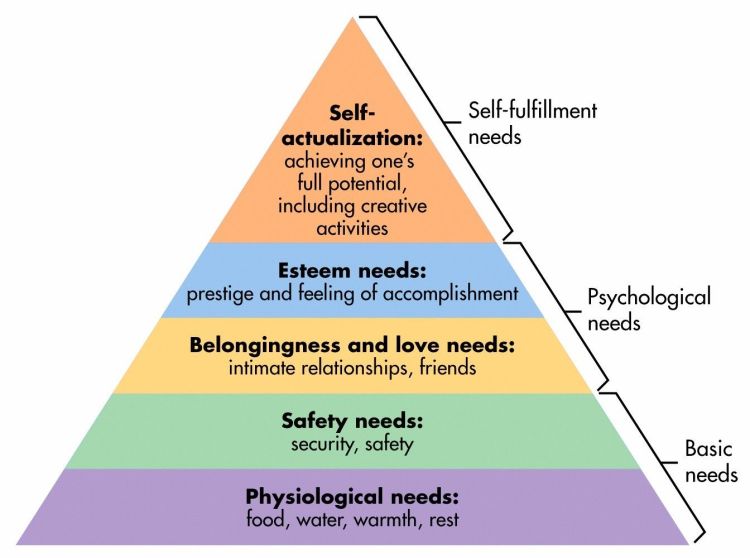
Before I elaborate on the 4 levels, I would like to use the Maslow’s Hierarchy of Needs as an introduction.
Level 1: Country
We have advanced greatly as a dominant species. Despite this, the inequality between countries are very apparent. Based on Factfulness by Hans Rosling, almost half of the world is living below $6 daily. Even today, majority of us do not have access to drinkable tap water. In addition, people in rural communities have to spend a few hours daily just to get water for their daily needs. If we compare the children in these communities with those in the developed urban cities, it is evident to deduce the outcome of their future based on the Maslow’s chart. The advantage in terms of resources & time provides the children who are born in such cities a head start and a platform moving at a higher speed than most countries.
Level 2: Racial Privilege
With the recent events happening around the world, we can’t dismiss the reality of racial discrimination and its toll on a person’s life. Racial Privilege is something that is prominent in some countries while it is almost obscure in nations that have high meritocracy. The issue of racial privilege is interdependent with the country. I would use an example of my home & neighbouring country as an example. Please read the 4 statements below thoroughly.
- A Chinese person in Malaysia is less privileged than a Chinese person in Singapore
- A Malay person in Malaysia is more privileged than a Malay person in Singapore
- In Malaysia, a Chinese person is less privileged than a Malay person
- In Singapore, a Malay person is not less privileged than a Chinese person
The statements above are pretty self explanatory. In terms of getting education or buying a home, every citizen in Singapore is given equal opportunity, no racial group gets ‘special privileges.’ However, in any community, no matter the governance, there will be a slight discomfort for the minority group in the social aspects of living. Although subtle, the contrast is present. To wind up, the speed of this platform is not absolute. It depends on the country. Being the majority can be favourable in many ways & it can be represented on the Maslow’s chart.
Level 3: Family Environment
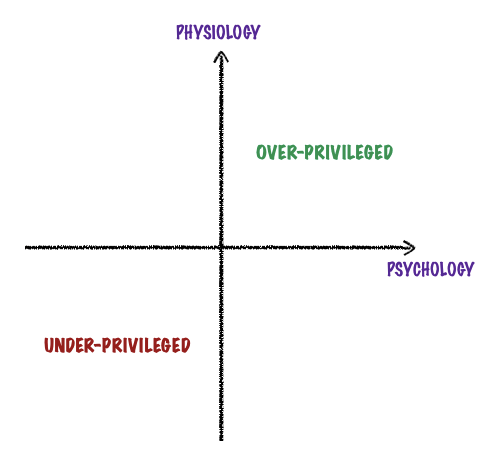
If we take 2 people from the same country & race, they still can be very distinguishable. The family you are born into plays a crucial role in your ‘fate.’ The key factor is resources. Resources are not only time & monetary. Stability & support can be as important in shaping a child. Parents who are financially inclined will have the opportunities to obtain resources such as having a caretaker & tuition lessons for their child. On the other hand, children who live with emotionally unstable parents will face turmoil, despite being financially stable.
I have made a simple chart below to categorize the groups.
Level 4: Personal
Finally, we made it to the last factor. As compared to the 3 external factors above, the personal level is something that entirely depends on sheer will. Many of us hear success stories of people who go from ‘rags to riches.’ It gives people hope & inspires them to improve.In spite of this, we can also be susceptible to survivorship bias. It is necessary for us to consider that the ‘success’ stories we hear are just the tip of the ice berg. The media only presents the 1% who succeed.
The above statement is not meant to discourage anyone. It is a benign reminder for all of us to be less harsh on ourselves & practice self-love.
Summary
To put things into perspective, imagine a variable speed for the 4 platforms.
- Speed of each platform varies from -5 till 5
- Max speed is 20 while minimum is -20
Points to consider:
- On surface level, people only care about your relative speed to theirs.
- On a personal level, even if you run at maximum speed, you can still have an overall negative speed & vice versa
- People who walk backwards can still be seen as moving forward & vice versa.
To conclude, success is based on multiple factors, mostly due to external factors which we cannot control.
I will end off with my personal quote:
The over-privileged succeed thanks to their environment
The under-privileged succeed despite their environment
Cheers & Mask Up!
 Leap with Luqe